

The Model
The Nature Positive Landscapes Model: A Framework for Action
The NPLI model is a globally applicable framework designed to drive the transformation needed for industry to contribute to the global Nature Positive goal. It expands management beyond site-specific impacts to encompass landscape stewardship, supply-chain management, and broader business and economic system change.
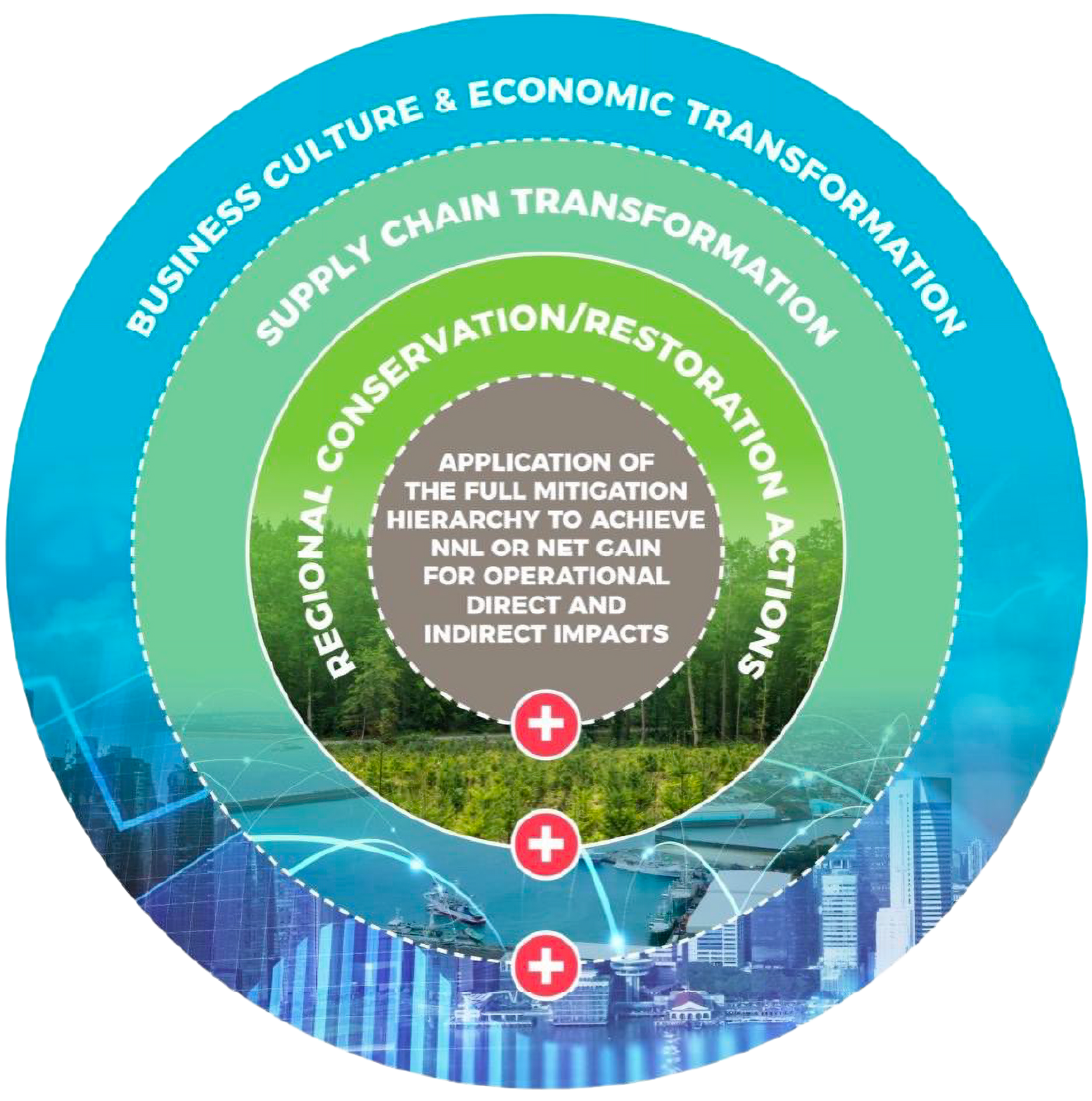

Direct Operations
Avoidance and minimization measures designed early in project planning.
Restoration of land degraded during mining operations.
Design of an offset program to reach NNL / NG goals through restoration of equivalent biodiversity.

Landscapes
Scaling mitigation, beyond NNL, to contribute to landscape targets.
Working with other companies from mining and other sectors, to address landscape scale pressures.
Taking additional actions to improve the state of nature within the landscapes companies interact with.

Value Chain
Working with suppliers to minimize the impacts of key commodities.
Investing in restoration programs to improve resilience of key commodities in supply chains.
Promoting the shift to recycled materials in value chains.

Business Systems
Board endorsement for Nature Positive approaches.
Clear duties of directors in managing nature-related risks.
Building monitoring and compliance mechanisms into company processes.
The Four Spheres of Influence
❋ Operational Footprint
Management of operational impacts to achieve No net Loss through the full use of the mitigation hierarchy.
❋ Landscape Planning
Collaborating with regional stakeholders to plan and deliver landscape-scale conservation initiatives that address priority regional conservation challenges.
❋ Supply Chain Transformation
Aligning supply-chain actors to work collaboratively in delivering Nature Positive outcomes across all stages of the supply chain.
❋ Systems Transformation
Transforming the financial and economic systems that shape private-sector decision-making to remove barriers and strengthen enablers for the widespread adoption of Nature Positive policies.

The Ten Core Principles
A set of ten key principles underpins the implementation of the Nature Positive model. These principles are essential for adapting business models towards the new opportunities and resilience that Nature Positive offers. They also form the foundation for the development of a Nature Positive industry standard.
The first three principles are particularly significant, as they may require new approaches that have not yet been widely adopted across the sector, at both company-wide and site-level operations.
-
Impacts and dependencies are addressed across the full scope of nature, including biodiversity (genetic, species, ecosystems and ecosystem services) across land, freshwater, oceans and atmosphere.
-
Biodiversity and ecosystem impact and dependencies in all parts of a business’s process and within its spheres of influence are covered, direct and indirect operational impacts, cumulative impacts, investments, and services.
-
Nature positive is a collective effort. Companies must Identify and engage with key stakeholders, including local communities, in the region, and across, value chains, to identify and plan necessary approaches.
-
Achieving Nature positive outcomes will require significant transformations of the economic, governance and business systems that underpin today’s global economy. For business, this means a commitment to adopting strategies that mainstream Nature Positive practices into business operations.
-
Nature Positive must be delivered in a manner that safeguards and enhances the rights and livelihoods of the indigenous peoples and local communities which depend on nature and its contribution to people, especially those underrepresented in traditional decision-making processes.
-
Achieving Nature Positive encompasses landscape-level planning and management of company operations and actions to address nature impacts in the area of influence of operations requiring coordinated planning with government, other companies and stakeholders. This moves companies beyond a traditional project only focus and approach.
-
Material impacts on nature can often be more important in supply chains compared to direct operations. Addressing nature risk in supply chains are necessary to achieve Nature Positive outcomes.
-
In a transformation to Nature Positive, the operation must at least achieve the goal of no net loss of biodiversity (and preferably a net gain) for its direct and indirect operational impacts. Nature Positive is achieved through conservation actions undertaken in the border landscape.
-
Targets and actions should be evidenced-based and integrated, and underpinned by a clear measurement framework that are aligned with global and jurisdictional goals (e.g., GBF, SDGs or NBSAPs) and clearly demonstrate contribution to the global goal of Nature Positive.
-
Companies should communicate in full transparency on the Nature Positive baseline, Nature Positive targets and actions, progress to target, as well as on challenges which constrain progress.
Resources & Technical Foundation
Access the peer-reviewed science and strategic papers that inform the foundation of our work, starting with The NPLI White Paper.
❋ NaturePositive.org (The Global Goal for Nature) – This serves as the primary scientific baseline for the model, defining "Nature Positive" as halting and reversing nature loss by 2030 based on a 2020 baseline.
❋ Kunming-Montreal Global Biodiversity Framework (GBF) – The international agreement adopted in December 2022 that provides the overarching mission for the NPLI model.
❋ European Union Business and Biodiversity Platform (2022) – Focused on integrating biodiversity value into business decision-making.
❋ UK Business and Biodiversity Forum (2022) – Provided foundational guidance for business transformation and sector-specific actions.
❋ IUCN IMEC Working Group (2023) – Developed the technical paper Nature Positive for Business
❋ IFC Performance Standard 6 (2012) – The industry standard for biodiversity conservation and the primary source for the "Mitigation Hierarchy" at the core of the model.
❋ IUCN Policy on Biodiversity Offsets (2016) – Provides the specific principles for the "compensation" or "offsetting" layer of the transformation requirement.
❋ Society for Ecological Restoration (SER) Standards – Informs the restoration and ecological recovery components of the model.
❋ World Business Council for Sustainable Development (WBCSD) – Provided the "Roadmaps to Nature Positive" that guide the business and supply chain transformation layers.
❋ Business for Nature – Authored the high-level policy recommendations and the "Assess, Commit, Transform, Disclose" (ACT-D) framework.